Jasmin Agić
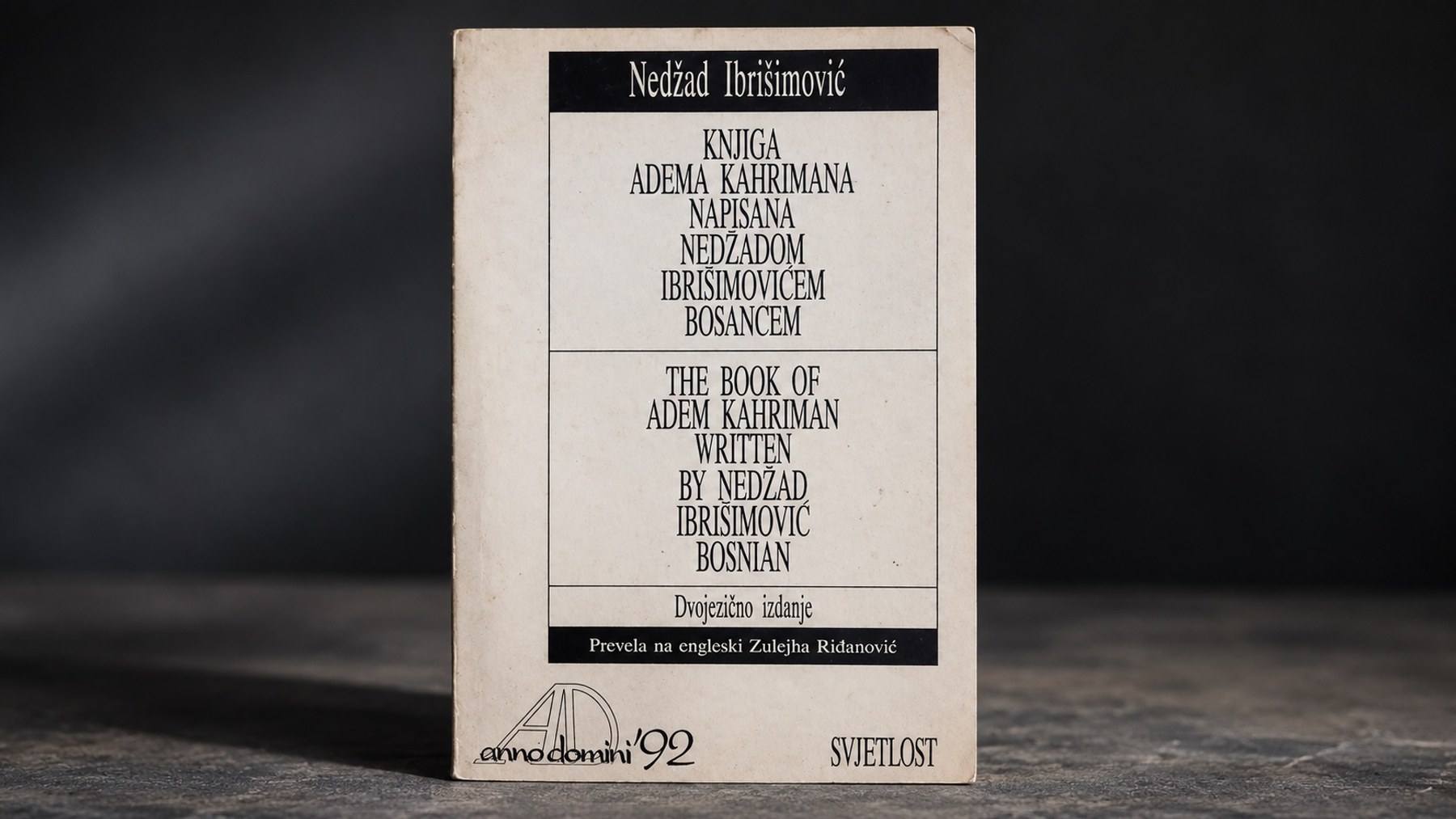
Probably almost entirely forgotten today, yet profoundly important and valuable, one of the most powerful works of Bosnian historiographic metafiction has a name: The Book of Adem Kahriman, Written by Nedžad Ibrišimović the Bosnian. The novel was written in the besieged Sarajevo neighborhood of Dobrinja during the first and most difficult year of the siege.
Although the novel was named Book of the Year, even within Ibrišimović’s own understanding of his literary work, it never occupied a particularly prominent place. It was not a novel he frequently revisited, interpreted, or singled out as an especially significant achievement within his oeuvre.
This marginal position was further reinforced by the writing and publication of Vječnik, the novel Ibrišimović himself considered his magnum opus. The public promotion of Vječnik, and the attention it attracted among literary critics and scholars, pushed The Book of Adem Kahriman even further into the background.
It seemed that the subject of the wars that had profoundly transformed the face of Bosnia no longer attracted readers’ attention. The reasons for this neglect can only be a matter of speculation.
The Book of Adem Kahriman, Written by Nedžad Ibrišimović the Bosnian is not an easy, accessible, or comfortable read, to put it colloquially. Its narrative is intense, its story difficult to grasp, and its literary technique, at least within the traditions of Bosnian and Yugoslav fiction, radically experimental.
The central subject of the novel is the history of Bosnia, more precisely its bloody and violent past, which, according to a Nietzschean notion of eternal recurrence, repeats itself endlessly, becoming more brutal and destructive with each new manifestation.
Against such a history, the novelist sets the idea of literature as the last instrument of idealistic humanism.
Trapped in besieged Dobrinja, his fictional alter ego, bearing the author’s own name, attempts, together with his literary companion Adem Kahriman, not only to save Bosnia and its people from another wave of mass slaughter, but also to undertake a quasi-ontological mission: to rescue those who were murdered and destroyed during the Second World War.
History repeats itself, and human destinies remain unchanged.
This is the central idea of Nedžad Ibrišimović, who, witnessing the destruction of Sarajevo and listening to the testimonies of Bosniak survivors of massacres in eastern Bosnia, realizes that events are unfolding according to an already familiar phenomenological pattern.
Time brings nothing new. It merely allows history to bring temporarily suppressed passions and restrained hatred back to the surface.
In besieged Dobrinja, the two friends attempt to save not the people arriving in Sarajevo after long and painful journeys of displacement from the regions along the Drina River, but their murdered ancestors, who had suffered identical fates half a century earlier.
And then, out of their visions, stories, conversations, and recollections, people murdered long ago begin to emerge on the pages of Adem Kahriman’s book.
The first is Hadži Tahirović from Foča, whose executioners, members of the Chetnik forces, flayed the skin from his back and pulled it over his head to make him resemble a Muslim woman wearing a headscarf.
After him comes an endless procession of those murdered in Chetnik atrocities committed in the upper Drina region.
All of them real. All of them people who once lived. Their lives and deaths documented in numerous reports on the victims of the Second World War, their suffering described in horrifying detail.
Yet they do not return simply as warnings or reminders. The tragedy of the Bosniak people in 1992 clearly suggests that history does not follow a dialectical path toward progress, and that dark and painful events can recur at seemingly precise intervals.
Nedžad Ibrišimović brings Hadži Tahirović back to life on the pages of Adem Kahriman’s book, powerless to save those being murdered in the reality of his own time.
But he does not stop there.
Researching documentary accounts of atrocities in eastern Bosnia, he discovers that the fate of the religious teacher Husein Effendi Talović mirrors that of those burned alive during the new devastation of Bosnia.
Talović, together with his entire family and approximately eighty fellow villagers from Vrsinje near Milići, was burned alive by Chetnik forces.
They were killed in the same manner as the victims of atrocities committed in Višegrad exactly fifty years later.
History in Bosnia does not unfold in the same way as it does in Western civilizations.
To paraphrase the great Heraclitus, it does not flow. It remains motionless, stagnant. It is not a river, but a filthy lake filled with horrifying secrets.
Unjustly neglected within Ibrišimović’s rich and diverse literary oeuvre, The Book of Adem Kahriman, Written by Nedžad Ibrišimović the Bosnian is, in every respect, an extraordinary work of fiction.
Bold, expressive, intellectually ambitious, and driven by a powerful idea — qualities all too rare in postwar Bosnian literature — the novel addresses questions that transcend the historical moment in which it was written and establishes the foundations of a literature that reaches beyond historiography.
With a profound understanding of historical and dialectical processes, expressed entirely through literary means, Ibrišimović created a novel that is far more than a testimony to lived reality.
It is a testimony to the brutal and bloody metaphysics of a place: our shared homeland, Bosnia, where bloodshed returns again and again, and where the innocent repeatedly become victims of persecution and massacre.
This essay is part of Artworks in the Siege, a project dedicated to artistic works created during the siege of Sarajevo. The project is scheduled to take place in the second half of November 2026 at the Charlama Gallery in Sarajevo.